Curriculum Overview
A clean beginner-to-advanced progression that builds the full six-layer stack.
Every lesson includes written instruction and a video walkthrough, plus an interactive quiz. Checklists and templates are embedded inside the lessons.
What This Course Builds
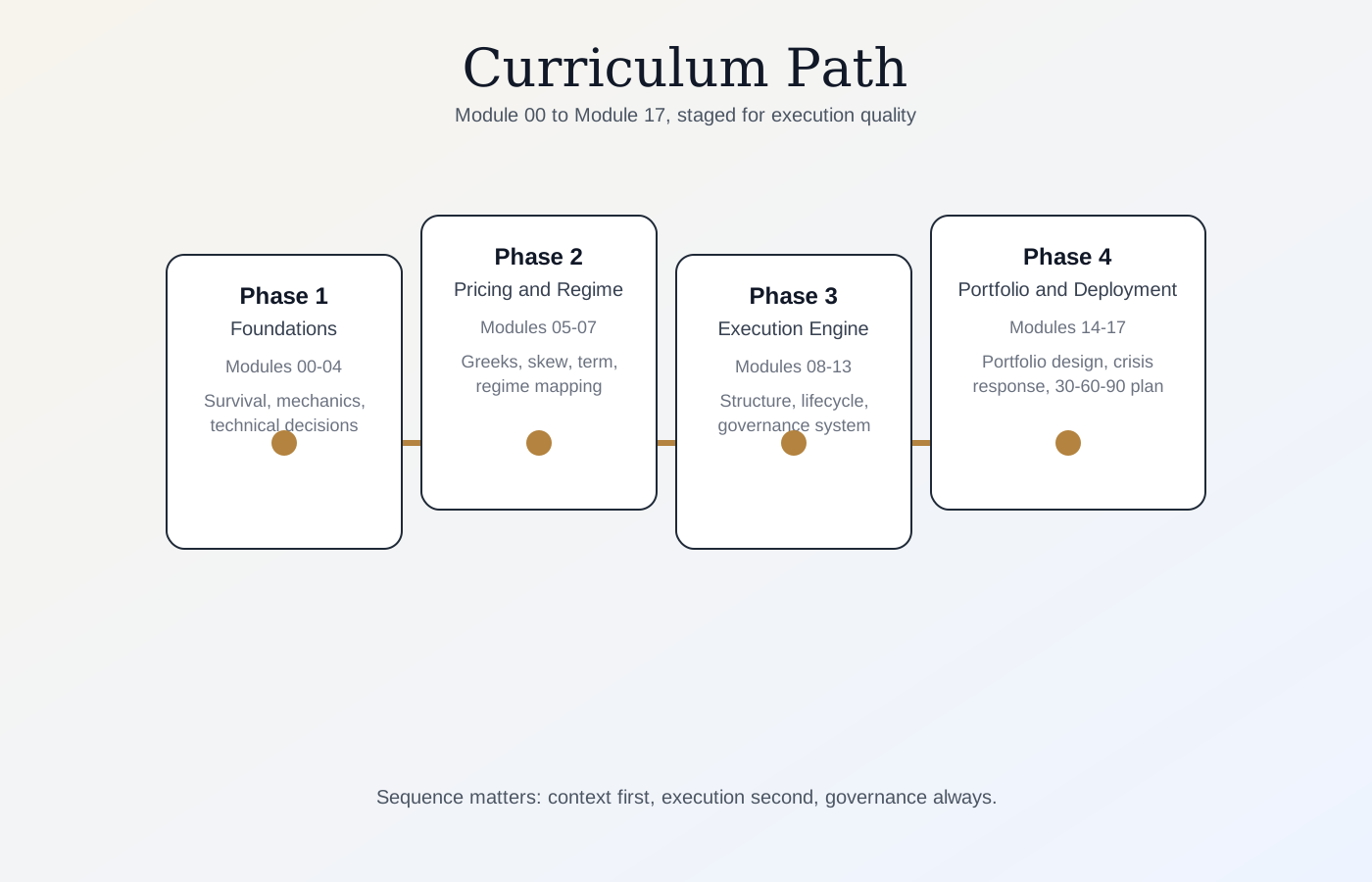
Table of Contents
Module 00 - Introduction and Course Onboarding
- Intro 01 - What Trading Actually Is (and What It Is Not)
- Intro 02 - Welcome, Course Outcomes, and How to Use This Program
- Intro 03 - Risk Disclosure, Ethics, and Trading Education Red Flags
- Intro 04 - Tool Setup and Study System - Broker, Journal, Data, and Review Rhythm
Module 01 - Survival and Integrity Foundations
- Lesson 01 - The Prime Directive - Capital Survival Before Return
- Lesson 02 - Conflict of Interest, Source Integrity, and Claim Verification
- Lesson 03 - Risk Units, Position Limits, and Personal Loss Rules
- Lesson 04 - Build Your Personal Trading Constitution and Kill-Switch Framework
Module 02 - Market Mechanics and Price Behavior
- Lesson 05 - Price Discovery, Auction Mechanics, and Liquidity
- Lesson 06 - Who Moves Markets - Participants, Flows, and Positioning Pressure
- Lesson 07 - Catalysts, Narrative, and Reflexivity in Price Movement
- Lesson 08 - Market Regimes and Transition Risk - Calm, Expansion, and Stress
Module 03 - Broker, Instruments, and Execution Infrastructure
- Lesson 09 - Broker Selection, Account Types, Margin Rules, and Platform Safety
- Lesson 10 - Instrument Roles - Stocks, ETFs, Futures, and Options
- Lesson 11 - Contract Specifications - Expiration, Assignment, Exercise, and Corporate Actions
- Lesson 12 - Order Routing, Slippage, Fees, and Execution Log Discipline
Module 04 - Technical Decision Frameworks
- Lesson 13 - Market Structure - Trend, Range, Breakout, and Failure
- Lesson 14 - Liquidity Zones, Support and Resistance, and Context Mapping
- Lesson 15 - Trigger and Invalidation Design for High-Quality Entries
- Lesson 16 - Multi-Timeframe Alignment and Technical Analysis Failure Modes
Module 05 - Options Mechanics, Greeks, and Probability
- Lesson 17 - Options Payoff Intuition and Structure Building Blocks
- Lesson 18 - Greeks for Live Decisions - Delta, Gamma, Theta, Vega, and Rho
- Lesson 19 - Probability, Expected Value, and Payoff Asymmetry
- Lesson 20 - Implied Volatility Fundamentals and Expected Move Construction
Module 06 - Volatility Pricing and Edge Context
- Lesson 21 - IV Rank, IV Percentile, and Relative Volatility Expensiveness
- Lesson 22 - Implied Versus Realized Volatility and Forecast Windows
- Lesson 23 - Skew - Strike-Level Pricing Distortion and Structure Implications
- Lesson 24 - Term Structure - Expiration Selection and Calendar Pricing Logic
Module 07 - Regime Alignment and Structure Selection
- Lesson 25 - Regime Labeling Framework for Trade Selection
- Lesson 26 - Signal-to-Structure Mapping by Regime
- Lesson 27 - Cross-Asset and Macro Confirmation for Better Context
- Lesson 28 - Pre-Trade Regime Checklist and Final Go Reduce No-Go Gate
Module 08 - Structure Design Toolkit
- Lesson 29 - Long Convexity Structures for Directional and Event Opportunities
- Lesson 30 - Premium Harvest Structures for Time Decay and Defined Risk
- Lesson 31 - Hybrid Structures - Calendars, Diagonals, and Relative-Value Builds
- Lesson 32 - Protection and Tail Engineering for Adverse Scenarios
Module 09 - Exposure and Position Engineering
- Lesson 33 - Risk Curve Design and Scenario-Based Payoff Mapping
- Lesson 34 - Delta Balance and Directional Exposure Control
- Lesson 35 - Gamma Placement and Time-to-Event Positioning
- Lesson 36 - Sizing, Scaling, and Correlation-Aware Exposure Stacking
Module 10 - Trade Lifecycle Management
- Lesson 37 - Entry Rules and Readiness Scoring Protocol
- Lesson 38 - Live Position Monitoring and Checkpoint Cadence
- Lesson 39 - Adjustment Playbooks - Reduce, Recenter, Rebuild
- Lesson 40 - Profit Harvesting, Exit Rules, and Post-Exit Review
Module 11 - Execution Quality and Regime Playbooks
- Lesson 41 - Convexity Versus Theta Map for Structure Choice
- Lesson 42 - Volatility Expansion Playbook
- Lesson 43 - Volatility Compression Playbook
- Lesson 44 - Integrated Skew and Term Structure Playbook
Module 12 - Risk Math, Psychology, and Consistency
- Lesson 45 - The Real Causes of Trading Losses and Attribution Discipline
- Lesson 46 - Risk of Ruin, Drawdown Math, and Recovery Constraints
- Lesson 47 - Behavioral Failure Patterns and Decision Hygiene Under Stress
- Lesson 48 - Consistency Framework - Process Adherence and Performance Review
Module 13 - Professional Operating System
- Lesson 49 - The Six-Layer Trading Stack
- Lesson 50 - Complete Decision Tree - Signal, Structure, Sizing, and Exit
- Lesson 51 - Journaling, Tagging, and Post-Mortem Workflow
- Lesson 52 - Daily, Weekly, and Monthly Operating Rhythm
Module 14 - Portfolio Construction and Allocation
- Lesson 53 - Portfolio Construction Principles and Diversification Logic
- Lesson 54 - Risk Budgeting and Capital Allocation Framework
- Lesson 55 - Exposure Netting - Delta, Vega, and Theta Across the Book
- Lesson 56 - Strategy Mix Design by Regime, Objective, and Risk Budget
Module 15 - Crisis, Liquidity, and Macro Response
- Lesson 57 - Crisis Trading Protocols and Volatility Shock Response
- Lesson 58 - Liquidity Event Playbook - Gaps, Slippage, and Execution Degradation
- Lesson 59 - Macro Regime Framework and Event Risk Integration
- Lesson 60 - Supplemental Forward-Looking Versus Backward-Looking Indicator Framework
- Lesson 61 - Hedging Programs and Portfolio Defense Under Stress
Module 16 - Portfolio Mastery and Integrated Capstone
- Lesson 62 - Portfolio-Level Convexity and Tail Control
- Lesson 63 - Professional Risk Curve Shaping Across the Portfolio
- Lesson 64 - Integrated Case Study - Calm, Transition, and Stress Regimes
- Lesson 65 - Build and Validate Your Personal Trading Playbook
Module 17 - Course Summary, Deployment, and Continuous Improvement
- Close 01 - Complete Course Debrief and Core Mental Models
- Close 02 - 30-60-90 Day Deployment Plan
- Close 03 - Paper-to-Live Transition Criteria and Safety Gates
- Close 04 - Continuous Improvement Roadmap and Professional Development Path